Quick verdict
The Fieldpiece DR82 fits refrigerant leak searches where a visible probe-tip alert and selectable zero modes are useful. Its main buying tradeoff is the infrared search technique: understand the response and refrigerant exclusions before paying for sensitivity claims.
Choose it for that task after checking refrigerant compatibility and service support. A sensitive detector can narrow a search, but a response alone does not establish the annual loss from a system or prove that every leak has been found. We have not handled or bench-tested a DR82.
Who should consider it
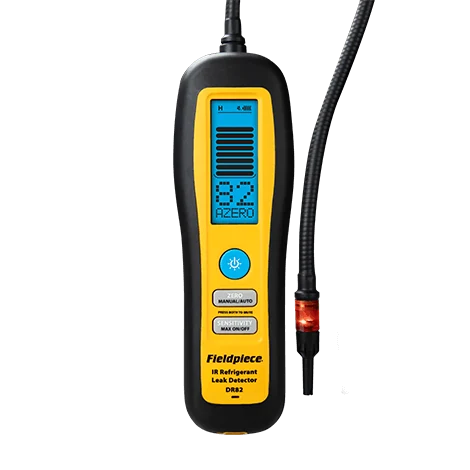
This model fits technicians who need a dedicated refrigerant detector alongside pressure, temperature and visual evidence. It is especially relevant when access makes it useful to watch the probe tip instead of repeatedly looking back at the instrument body. A general combustible-gas search requires a detector specified for that different task.
Documented specifications
The following details come from the DR82 product page and v06 operator manual. These are manufacturer specifications, with different sensitivity conditions for a stationary tip and a moving search.
| Specification | Manufacturer documentation |
|---|---|
| Sensor | Infrared (IR) |
| Maximum sensitivity | 0.03 oz/year stationary; 0.1 oz/year in motion |
| Indication | Relative 0–99 units, bar graph, red tip LED and beeper |
| Battery | Internal non-replaceable lithium-ion; 10 hours typical with backlight off |
| Environmental range | 32–104°F (0–40°C); below 75% RH, non-condensing |
| Refrigerant boundary | HFC, HCFC, CFC, HFO and blends; manual prohibits A3 refrigerants and combustible atmospheres |
Understand the zero mode before judging a response
The manual distinguishes automatic zero, which updates the baseline every four to five seconds, from manual zero, which holds the baseline until reset. Its number represents relative concentration in 0–99 units. Do not report that display as parts per million or ounces per year.
That distinction matters when evaluating a demonstration. An indication that fades while a tip remains still can reflect the selected baseline behavior. It does not, by itself, prove that refrigerant stopped escaping. Record the mode used and compare repeat passes made with a consistent approach.
For a DR82 vs. DR58 comparison, Fieldpiece describes the DR58’s heated-diode sensor as responding to absolute concentration, while the DR82’s infrared sensor follows concentration changes. The manufacturer also identifies mechanical-disturbance sensitivity as an infrared consideration. Compare the search technique and sensor-maintenance needs with your work; this review has no side-by-side detection test or basis for declaring either detector universally better.
Sensitivity has conditions
Treat the stationary and moving sensitivity figures as different specifications. The better stationary figure should not silently become a promise for every moving search. A purchase comparison is more useful when both instruments are evaluated under equivalent conditions with an appropriate reference and a stated procedure.
Before buying, ask the supplier to explain an appropriate functional check and service route. A tool that powers on and displays numbers has demonstrated only part of what matters. If an important job depends on detector confidence, decide in advance how you will verify function and obtain support when a result is doubtful.
An alarm is a search clue
A useful job record describes the suspected component, operating conditions, detector mode and whether the response was repeatable. Separate that observation from the repair conclusion. This makes it easier for another technician to understand why a particular joint was selected for confirmation or repair.
Avoid turning a reassuring pass into a universal statement that a system is leak free. Access, operating conditions and the search method limit what any inspection can establish. The buying question is whether the DR82 helps you gather stronger location evidence within the time and access available.
Refrigerant and environment limits
The DR82 manual prohibits use in a combustible gas atmosphere and with A3 refrigerants such as propane R-290 and isobutane R-600. The product’s A2L labeling does not remove those exclusions. Verify the exact refrigerant and the equipment documentation before choosing a detector for a new service category.
This is a practical selection limit for refrigeration work: a shop servicing different refrigerant families may need more than one detector. Compare your actual equipment list with documented coverage instead of assuming that a general description of refrigerant detection includes every fluid you encounter.
Filters, battery and ownership
The manufacturer documents replaceable filtered tips and a permanently installed battery. Price replacement tips and ask how battery or sensor problems are handled. The advertised typical sensor life is a design claim, not a ten-year service result observed by this review.
Make room for the case, charging routine and clean storage in the purchase decision. A detector that is unavailable because it was not charged or because a replacement part cannot be obtained has little value on the job that needs it. We have not verified current replacement-part or service prices.
Buying checklist
- Confirm the exact DR82 model, included case, charger and filtered tips.
- Match the instrument’s documented refrigerant and environmental limits to your work.
- Check the seller’s authorization, return conditions and service route.
- Budget for filtered tips and a charging routine, with a plan for service downtime.
The Amazon link identifies an exact-model listing; it does not confirm every offer or seller that may appear there. Fieldpiece’s marketplace policy requires authorization for marketplace selling. Verify the selected seller with the manufacturer when warranty support affects the decision.
Our recommendation is to shortlist the DR82 when infrared leak searching fills a clear gap in your kit. Ask for a meaningful demonstration of the zero modes and repeatability, then judge the complete ownership arrangement. This article is documentation-based buying analysis, with no independent sensitivity or durability test.
Manufacturer specification reference
Fieldpiece · DR82 · DR82 Infrared Refrigerant Leak Detector
These are manufacturer specifications, not independently measured results.
- Sensor
- Infrared (IR)
- Maximum sensitivity
- 0.03 oz/year stationary; 0.1 oz/year in motion
- Indication
- Relative 0–99 units, bar graph, red tip LED and beeper
- Battery
- Internal non-replaceable lithium-ion; 10 hours typical with backlight off
- Environmental range
- 32–104°F (0–40°C); below 75% RH, non-condensing
- Refrigerant boundary
- HFC, HCFC, CFC, HFO and blends; manual prohibits A3 refrigerants and combustible atmospheres
Related BAS Bridge learning
Sources & verification
Follow the current manufacturer instructions for your exact model. Specifications and source revisions can change.
- Fieldpiece DR82 product specifications ↗
Model identity, infrared sensor, published sensitivity conditions, battery and environmental limits.
Checked Oct 29, 2026 · Source publication date: Unknown - Fieldpiece DR82 operator manual v06 ↗
Zero modes, relative 0–99 indication, filtered-tip maintenance, battery construction and A3/combustible-atmosphere exclusions.
Checked Oct 29, 2026 · Source publication date: Unknown - Fieldpiece DR58 and DR82 comparison FAQ ↗
Manufacturer explanation of infrared concentration-change behavior and mechanical-disturbance sensitivity.
Checked Oct 29, 2026 · Source publication date: Unknown - Fieldpiece online marketplace policy ↗
Marketplace authorization requirements; not proof that a particular Amazon seller is authorized.
Checked Oct 29, 2026 · Source publication date: Unknown - Amazon DR82 exact-model listing ↗
Purchase identity only: Amazon productTitle identifies Fieldpiece DR82 and page ASIN matches B09G963HQ6. No prices, ratings or customer-review claims imported.
Checked Oct 29, 2026 · Source publication date: Unknown - Fieldpiece DR82 official product image ↗
Exact-model image linked from the manufacturer product page and visually checked for product identification. The image is not evidence of BAS Bridge ownership or testing.
Checked Oct 29, 2026 · Source publication date: Unknown
Editorial context
Prepared by BAS Bridge from linked manufacturer documentation and original buying analysis. This article does not claim firsthand use or independent performance measurements.
Manufacturer product information and operator documentation were checked on October 29, 2026. Practical buying conclusions are editorial analysis; no physical testing or service-call experience is claimed.
No current price, stock level, customer star rating, or measured reliability rate is implied.
Methodology & disclosure →