Quick verdict
The Fieldpiece JL3KH6 combines two pressure probes, two pipe clamps, and two psychrometers for refrigerant and air measurements in Job Link. It suits a phone-based diagnostic workflow, particularly when you need both sides together. It does not include a micron gauge or the complete equipment for refrigerant transfer and evacuation.
The tradeoff is dependence on a compatible mobile device and a collection of separate probes. This kit suits a technician who is comfortable organizing tools in an app. If you want an instrument-mounted screen and a conventional valve block, compare the Fieldpiece SM482V instead.
Reasons to consider it
- Six probes cover several measurements in one purchase.
- Direct pressure connections reduce the need to connect a manifold solely for readings.
- Separate sensors let you choose measurement locations independently.
Reasons to look elsewhere
- The phone becomes part of the working instrument.
- Six separate tools require battery, storage, and inventory habits.
- The kit does not include a micron gauge or a refrigerant-transfer assembly.
Evidence behind this review
This research-based review was checked October 29, 2026. The public article draws on the exact kit page, the three component manuals, and official supporting guidance. Manufacturer specifications and our practical interpretation are identified separately below. We have not used this kit on service calls or independently tested accuracy, connection losses, radio range, battery life, or durability.
Our recommendation concerns the kind of workflow the kit supports. It is not a claim that it will make every technician faster. The best evidence for that question would be your own repeated comparison of complete service tasks, including setup, recording, and cleanup, under similar conditions.
What comes in the JL3KH6 kit?
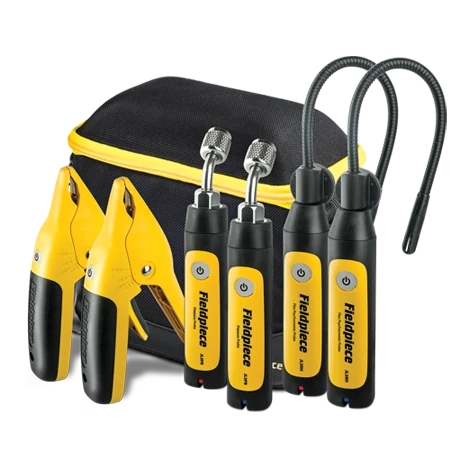
Fieldpiece lists two JL3PR pressure probes, two JL3PC pipe-temperature clamps, two JL3RH flexible psychrometers, a padded case, and two AAA batteries per probe. That is six measurement tools and twelve batteries in total.
The model matters. A charge-only package and a charge-and-air package are different purchases. Check the exact JL3KH6 designation and the itemized contents of the seller’s offer. Do not assume that additional tools pictured alongside the kit are included.
| Component pair | Buying purpose |
|---|---|
| Pressure probes | Refrigerant-side operating measurements |
| Pipe clamps | Temperatures at selected conductive pipes |
| Psychrometers | Air temperature and humidity measurements |
| Compatible phone or tablet | View and organize the readings |
| Separate transfer and evacuation tools | Complete work the probe kit does not perform |
This is an integrated measurement purchase, not an entire refrigeration service kit. That distinction is particularly important for an apprentice assembling equipment from scratch. Someone who already owns transfer and evacuation tools can evaluate the kit as an addition; someone starting with nothing needs a much broader budget.
The practical value of a combined view
Imagine a service visit where you need to compare conditions at the outdoor unit with conditions at the air handler. The appeal of separate wireless probes is leaving each sensor at its measurement point while bringing the information together. Our interpretation is that this can make comparison more convenient, especially when the relevant locations are separated.
The benefit depends on whether that shared view changes the way you work. If you normally record one reading and move on, a connected system may add setup without giving you much more insight. If you repeatedly need to compare changing values, the combined view is more persuasive.
Fieldpiece’s workflow guidance discusses evaluating airflow and refrigerant conditions together and includes static-pressure measurement as a separate part of the process. The important buying implication is that the JL3KH6 broadens the information available; it does not provide every measurement needed to diagnose a complete system.
Before ordering, list the readings your common jobs require. Mark which ones this kit supplies and which ones still come from other tools. That exercise prevents a broad product name from turning into an assumption of complete diagnostic coverage.
Pressure probes: range, connections, and expectations
The JL3PR manual specifies a 580-psig upper measurement limit, with ±1-psig accuracy from 0–200 psig and ±2 psig from 200–580 psig. Its 800-psig overload limit is a separate specification, not an extended measurement range. The manual also directs users to turn the fitting by hand rather than using the plastic body for leverage.
Our purchasing implication is to check your actual equipment pressures and connection requirements before considering convenience. An angled probe can still need an adapter or a different connection arrangement on a particular system. Compactness should be judged at the service port, with nearby panels and tubing considered, rather than from the probe’s photograph alone.
Directly attached pressure probes also change the way you arrange refrigerant-transfer work. Think through where the additional hoses and fittings would connect and whether the probes can remain in the positions you want. The kit’s attraction is measurement flexibility; it does not eliminate the need to plan other connections.
The pressure probes are not deep-vacuum instruments. If evacuation verification is part of the purchase, budget for a separate micron gauge and an appropriate setup.
Pipe clamps: the contact requirement matters
The JL3PC manual identifies conductive piping from one-quarter to one-and-three-eighths inches as its intended range. The Rapid Rail design uses the pipe as part of the thermocouple circuit. The stated temperature accuracy is ±1°F, and the manufacturer describes a typical three-second stabilization time. Neither specification is a measurement from this review.
This makes pipe suitability an important buying check. Ask whether the lines you normally measure fit the jaw and provide the required contact. Also consider how you would place the clamp when insulation, bends, or adjacent components restrict access. A nominal pipe-size range cannot answer every access question.
The manual includes contact feedback and a calibration check. Our ownership recommendation is to learn what those indications mean before the first job. A sensor that reports a contact problem is asking you to inspect the setup; treating every missing reading as a radio problem would waste time.
We have not assessed clamp comfort with gloves or repeated opening effort. If those factors matter to you, handle the exact model before committing or use the seller’s normal return process to evaluate fit without assuming the specifications settle the question.
Psychrometers: why the air side changes the purchase
The JL3RH manual describes a flexible probe, adjustable magnetic positioning, and measurements including dry bulb and relative humidity. It specifies ±2.5% RH within 10–90% RH at 73.4°F, with different limits outside that band. Its typical humidity response is sixty seconds for ninety percent of the total change.
The practical implication is to allow the air measurement its own settling time. A rapidly displayed pipe temperature does not establish that a humidity sensor moved from another environment has finished responding. Compare instruments by the readings you need, with their stated conditions, instead of assuming every value updates meaningfully at the same pace.
Deciding where to put the air probes deserves thought as well. Can you reach the relevant air stream and secure the probe? Is there an existing suitable access point? The manual warns against drilling blindly into a plenum containing a coil or heat exchanger. Access planning belongs ahead of convenience.
The two psychrometers are the main reason to choose this broader kit over a charge-only purchase. If you already own air-measurement tools that suit your work, compare the cost and usefulness of duplicating them. If you repeatedly need simultaneous air and refrigerant information, their inclusion becomes easier to justify.
Phone, radio range, and reporting
The kit’s documentation advertises up to 1,000 feet of wireless range in line of sight. Obstructions affect distance. We have not tested communication through buildings or equipment, so the advertised range should not become a promise about your particular site.
Treat your mobile device as part of the purchase decision. Confirm current app compatibility on the exact device you intend to carry. Think about screen visibility, battery condition, gloves, charging, and where the device will sit while your hands are busy. These factors can matter more than the radio’s maximum distance.
Fieldpiece’s Job Link plan page separates free live measurements and reports from paid business features. Check current availability for your needs. Our recommendation is to try the app’s organization and reporting approach before making a connected-tool ecosystem central to your work.
Keep a distinction between displaying useful measurements and producing a useful service record. A report still needs the correct equipment, operating conditions, and explanation. Adding connected tools does not automatically supply that context.
JL3KH6 vs SM482V: probes or a local-display manifold?
Budget beyond the kit price. Consider adapters for your equipment, transfer tools, a micron gauge, replacement seals, batteries, and a compatible device you can keep available. Add only what you lack; avoid counting accessories you already own twice.
Compare three realistic options. Keeping your existing instruments is sensible if they already answer the questions you face. Buying selected probes may suit a kit with only one weak area. Buying the JL3KH6 makes more sense when you need its broader group of measurements and prefer the shared app view.
The SM482V manifold is another candidate when a local screen and valve block are central to your routine. This review does not establish either arrangement as universally better. It explains why the answer changes with the proportion of diagnostic visits, repairs, and commissioning work you perform.
For an Amazon purchase, check the particular seller and contents. Fieldpiece requires authorization for third-party marketplace selling, and the component manuals tie their limited warranty to authorized-dealer purchases. Verify the chosen offer with Fieldpiece instead of assuming that either the marketplace or the product title settles warranty coverage.
Final recommendation
Before putting a new kit into daily service, make its organization familiar. Match each probe’s identity to its app assignment, confirm which components belong at which measurement points, and plan a storage check that accounts for all six tools. Compare any suspected measurement issue with a suitable reference and the relevant manual before deciding whether it is a setup problem or a defective instrument. Keep those checks distinct from a long-term reliability judgment. A successful first connection establishes that you can use the arrangement; repeated field work is what will show whether the arrangement is worth carrying.
Choose the JL3KH6 when you need the included air and refrigerant measurements, are comfortable working through a phone, and have a complete plan for the jobs the kit does not cover. Its value is strongest when the combined view solves a recurring information or handling problem.
Wait if you are buying mainly for an advertised range, an unmeasured time-saving claim, or the impression that six probes replace an entire service kit. Identify the missing capability in your current tools first. That gives you a concrete reason to buy the full kit, buy fewer tools, or keep what already works.
Manufacturer specification reference
Fieldpiece · JL3KH6 · JL3KH6 Job Link Charge and Air Kit
These are manufacturer specifications, not independently measured results.
- Included tools
- Two JL3PR pressure probes, two JL3PC pipe clamps, two JL3RH flex psychrometers
- Included power
- Two AAA batteries per probe, twelve total
- Display
- Compatible mobile device running Job Link app; no local numeric screen on each probe
- JL3PR measurement
- 29 inHg vacuum to 580 psig; not a deep-vacuum micron gauge
- JL3PR positive-pressure accuracy
- ±1 psig from 0–200 psig; ±2 psig from 200–580 psig
- JL3PC pipe sizes
- Electrically conductive 1/4–1-3/8-inch piping
- JL3PC temperature accuracy
- ±1°F (±0.6°C) within manual conditions
- JL3RH humidity accuracy
- ±2.5% RH at 10–90% RH at 23°C; different limits outside that band
- Wireless range
- 1,000 feet line of sight; obstructions affect distance
Related BAS Bridge learning
Sources & verification
Follow the current manufacturer instructions for your exact model. Specifications and source revisions can change.
- Fieldpiece JL3KH6 official kit specifications ↗
Official documentation consulted for the documented capabilities and limitations. The article distinguishes source specifications from editorial interpretation.
Checked Oct 29, 2026 · Source publication date: Unknown - Fieldpiece JL3PR pressure probe operator manual ↗
Official documentation consulted for the documented capabilities and limitations. The article distinguishes source specifications from editorial interpretation.
Checked Oct 29, 2026 · Source publication date: Unknown - Fieldpiece JL3PC pipe clamp operator manual ↗
Official documentation consulted for the documented capabilities and limitations. The article distinguishes source specifications from editorial interpretation.
Checked Oct 29, 2026 · Source publication date: Unknown - Fieldpiece JL3RH flex psychrometer operator manual ↗
Official documentation consulted for the documented capabilities and limitations. The article distinguishes source specifications from editorial interpretation.
Checked Oct 29, 2026 · Source publication date: Unknown - Fieldpiece Job Link system plans and features ↗
Official documentation consulted for the documented capabilities and limitations. The article distinguishes source specifications from editorial interpretation.
Checked Oct 29, 2026 · Source publication date: Unknown - Fieldpiece wireless measurement workflow guidance ↗
Official documentation consulted for the documented capabilities and limitations. The article distinguishes source specifications from editorial interpretation.
Checked Oct 29, 2026 · Source publication date: Unknown - Fieldpiece online marketplace policy ↗
Official documentation consulted for the documented capabilities and limitations. The article distinguishes source specifications from editorial interpretation.
Checked Oct 29, 2026 · Source publication date: Unknown - Fieldpiece JL3KH6 official product image ↗
Exact-model image linked from the manufacturer product page and visually checked for product identification. The image is not evidence of BAS Bridge ownership or testing.
Checked Oct 29, 2026 · Source publication date: Unknown
Editorial context
Published by BAS Bridge from linked manufacturer documentation and original buying analysis. The review does not claim firsthand experience or independent performance measurements.
Manufacturer product information and operator documentation were checked on October 29, 2026. Practical buying conclusions are editorial analysis; no physical testing or service-call experience is claimed.
No current price, stock level, customer star rating, or measured reliability rate is implied.
Methodology & disclosure →