Quick verdict
The MWT-S1 is a useful small-forming candidate when localized bends and accessible edges are the work. Larger repetitive folds may call for a different tool or blade arrangement.
This is a research-based review of the exact model, using the linked official documentation and original buying analysis. We have not performed hands-on or comparative testing. Amazon customer reviews and star ratings are not reproduced or represented as independent evidence.
The useful job is a localized bend
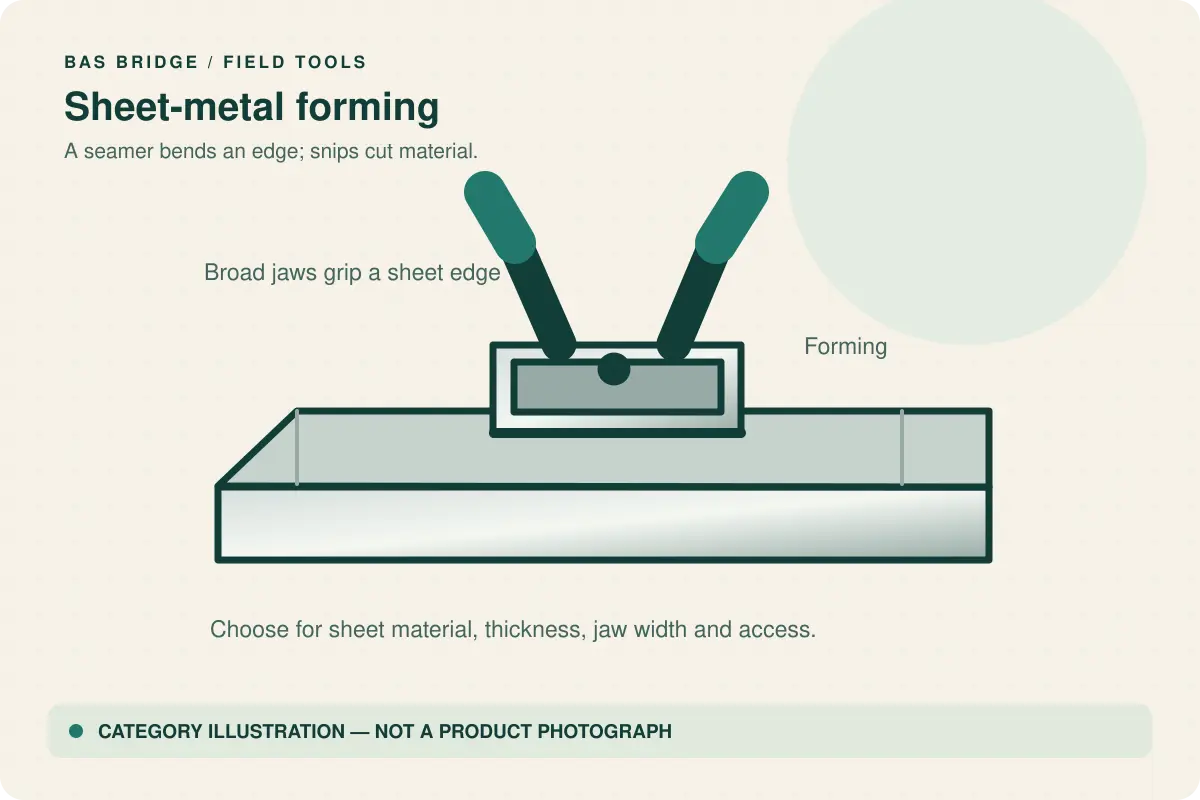
The Midwest MWT-S1 is worth considering when a service kit needs a hand tool for small, accessible sheet-metal forming tasks. A localized flange or edge adjustment is a different problem from making long repeated folds in a shop. Thethree-inch jaw size is therefore both its practical identity and its limit.
A hand seamer can fit work that would be awkward to bring to a larger brake, but portability does not automatically make it the best choice for every bend. Start with the length, material, access and finish required. Repeated long folds may justify another tool even when a short seamer could eventually complete them.
What the S1 specifically provides
Midwest describes 3 by 1-1/4 inch forged blades,1/4 inch sight graduations and a straight-handle interchangeable-blade arrangement. Those details help a buyer evaluate layout and the size of each grip. The official page discusses alternate blade lengths, but that does not mean every option is included with the S1.
Check the actual package before assigning value to the blade system. An interchangeable design is useful when compatible parts are available and solve a foreseeable task. It is less useful when the buyer expects a wider blade in the box and discovers only the standard configuration arrived.
A short jaw needs a layout plan
For a longer edge, separate grips need to follow the same intended line. Small changes in insertion or angle can leave an uneven result. The sight graduations are a useful reference, but they do not replace marking and checking the actual bend.
A practical comparison is to try a suitable offcut of the material and gauge used in your work. Evaluate the finish and access rather than assuming every sheet-metal tool performs identically on every alloy or thickness. This review supplies no universal gauge capacity where the exact source does not establish one.
A duct-service example
Consider a small patch or accessible flange that needs a controlled bend before fastening. The S1 could fit the localized forming task while snips address the cutting and a crimper addresses a different joining geometry. The tools are complementary because they change the material in different ways.
The finished piece still needs to suit the duct or equipment requirements. A neat bend does not establish airflow performance, sealing quality or structural suitability. The example explains where the tool fits; it does not claim that this site fabricated or tested a completed repair with it.
Compare straight and offset approaches
A straight-handle seamer and an offset model can place the user's hand differently relative to the work. That is a meaningful access comparison to make with a demonstration. Do not assume the straight S1 is automatically better because its shape looks simpler or the offset alternative is always better because it looks more specialized.
Likewise, a folding tool or brake can be the better choice when a long consistent line is the main requirement. Compare the operation you repeat most, not just the width of the largest jaw you can buy.
Check the complete forming kit
Verify MWT-S1 identity, installed blades, compatible replacement parts and any separately sold blade kit. Inspect jaw alignment and edges when evaluating a used tool. Current blade and replacement-part costs were not verified for this review.
Choose the S1 for localized forming where its documented geometry is useful. Keep material suitability and the quality of the finished piece in the decision. This assessment includes no hand-force, bend-consistency, edge-marking or long-term durability test.
Reasons to consider it
- Three-inch forged blades
- Sight graduations
- Interchangeable blade system
Tradeoffs to consider
- No universal material/gauge approval claimed
- Long edges need careful layout
- Not a substitute for every brake operation
Manufacturer specification reference
Midwest · MWT-S1 · Midwest MWT-S1 3-Inch Straight Hand Seamer
These are manufacturer specifications, not independently measured results.
- Blade face
- 3 × 1-1/4 inch forged blades
- Layout references
- 1/4 inch sight graduations
- Type
- Straight-handle seamer with interchangeable blades
Related BAS Bridge learning
Sources & verification
Follow the current manufacturer instructions for your exact model. Specifications and source revisions can change.
- Midwest MWT-S1 official specifications ↗
Official model documentation checked for the features and limits discussed in this original research review. Specifications are manufacturer claims; buying judgments are editorial analysis.
Checked Nov 2, 2026 · Source publication date: Unknown
Editorial context
Independently written BAS Bridge research review. Manufacturer features are distinguished from editorial judgments. No firsthand use or measured comparative performance is claimed. Amazon customer reviews and star ratings are not copied or synthesized into ratings.
The linked official product documentation was checked on November 2, 2026. This article combines documented features with original task-based analysis. No physical testing, service-call use, Amazon customer-review consensus or independent performance measurement is claimed.
No current price, stock level, customer star rating, or measured reliability rate is implied.
Methodology & disclosure →