Quick verdict
The NTE11L is a strong candidate when repeated expansion of compatible soft or annealed copper justifies powered actuation. Its value depends on the actual head set and complete joint-making workflow; the tool does not turn an expanded socket into a finished, tested joint.
This is a research-based review of the exact model, using the linked official documentation and original buying analysis. We have not performed hands-on or comparative testing. Amazon customer reviews and star ratings are not reproduced or represented as independent evidence.
Buy the right operation for the joint
The NAVAC NTE11L expands tubing; it is not the NEF6LM flaring tool. That difference is central to a sensible purchase. If the work calls for a flare, a different connection or a fitting with a specified joint preparation, a powered expander is not a substitute merely because both tools appear in the same copper-working range.
NAVAC documents the NTE11L for soft or annealed copper, with seven head sizes spanning 3/8 to 1-1/8 inch OD. Its listed battery is 7.4 V, 2 Ah, and its stated weight with the battery is 3.4 lb. Those facts establish a useful starting scope; they do not establish compatibility with every copper temper, wall thickness or material found on a job.
The material is part of the compatibility check
An expander must be assessed against the actual tubing, not just its nominal diameter. The manufacturer's material condition matters because forming a socket changes the tube end. A tool that moves successfully is not evidence that unsuitable material was safe to form or that the finished geometry meets the connection requirement.
Before buying, compare the documented tubing scope with the work orders you expect. Identify any sizes or materials that require a different tool, fitting or process. That exercise may reveal that a powered kit is useful for the majority of repeated work while still leaving a legitimate role for another preparation method.
Count the heads in the exact offer
The manufacturer's documented size range is helpful, but a kit photograph is not enough to confirm the heads included with a particular seller offer. NAVAC identifies configurations with different accessory omissions. Similar suffixes can therefore produce meaningfully different packages even when the central tool looks the same.
List every required head, battery, charger and storage item before comparing prices. If you already own part of the system, ask the manufacturer or authorized supplier to confirm exact compatibility rather than assuming a matching voltage establishes it. Avoid treating a cheaper bare or reduced package as an equivalent complete kit.
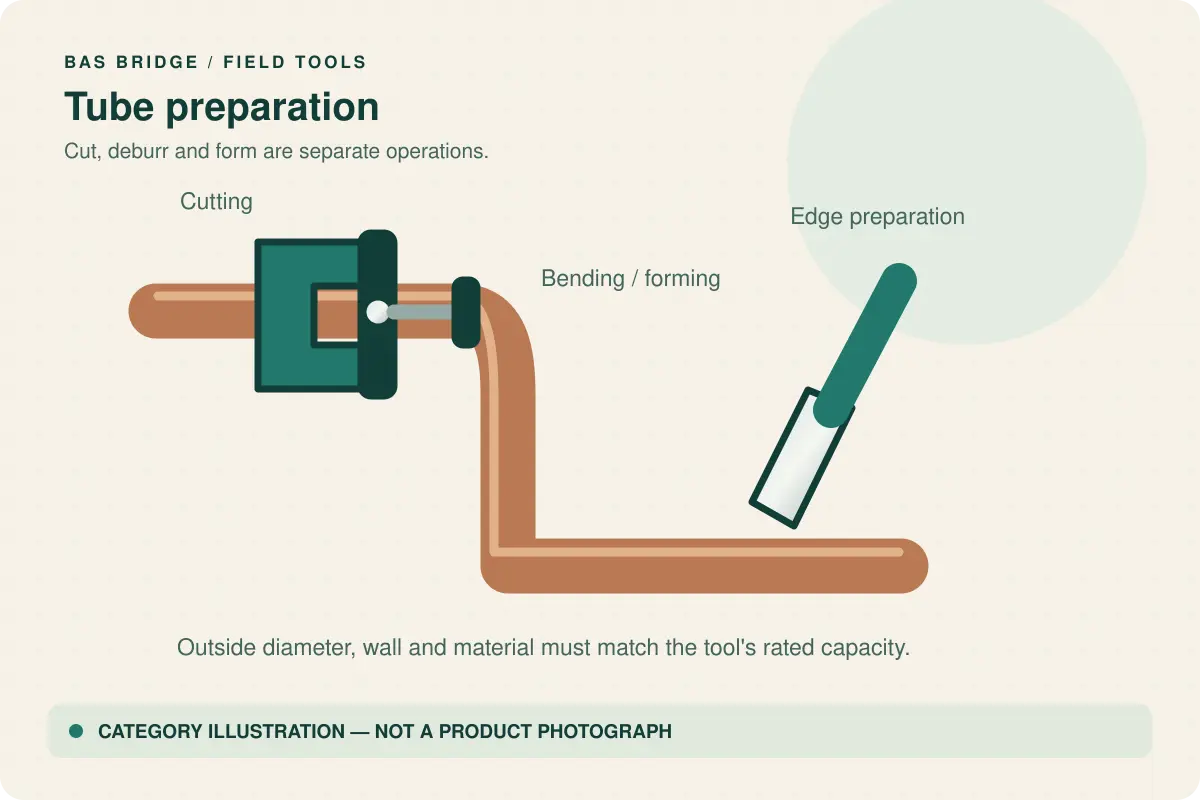
Expansion is one stage of a finished joint
A powered expansion cycle can change the hand effort involved in preparing a socket. The full joint still depends on suitable cutting and preparation, correct fit, the specified joining process and verification. The NTE11L cannot inspect the interior of the finished joint or establish that the complete refrigerant circuit is leak free.
That limits what can responsibly be claimed about productivity. Fewer separate couplings may be useful in an appropriate design, but a tool purchase does not authorize changing the installation requirements. We have not measured fitting consumption, complete joint time or leak rates with this model. Any savings calculation must use a permitted method and real observations from your work.
When powered actuation earns its place
Repeated compatible expansion is the clearest use case. If the manual action is a recurring source of effort and the head changes fit the sizes you use, cordless actuation may solve a concrete problem. If expansion is rare, a suitable manual or hydraulic kit may already meet the need without another charging routine.
Think about the work location as well as frequency. A tool that is convenient on a bench may have a different practical fit near installed piping. Head access, tool orientation and the length of tube available for preparation deserve attention before ordering. We have not carried out clearance trials on actual equipment or assessed the grip through repeated production work.
Compare it with a hydraulic kit fairly
The Yellow Jacket 60493 offers a manual hydraulic approach with its own documented head set and accessory package. That is a useful comparison because it changes the actuation and readiness requirements, rather than simply offering another color of battery tool. Neither approach can be declared universally better from a catalog.
Compare the required size coverage, working space, complete carrying kit, preparation accessories and service support. A hydraulic tool avoids battery readiness but still has a mechanism to maintain. A cordless tool changes the actuation routine but adds battery and charger questions. We have not performed a controlled force, speed or durability comparison.
Ownership and the final buying decision
Ask how replacement heads, batteries and repair support are obtained for the exact model. Keep the heads identifiable and stored with the kit so a missing size is found before the job. Current accessory and service prices were not verified, so this review does not turn those questions into a guessed annual operating cost.
Choose the NTE11L when its supported material and head coverage match frequent work, and the powered step solves a repeated effort problem. Choose a smaller or existing solution when the task is occasional or the required sizes are few. The most defensible upgrade is a complete joint-making process with a useful powered stage, rather than an assumption that a powered cycle guarantees the joint.
Reasons to consider it
- Cordless actuation addresses repeated expansion effort.
- Manufacturer documents seven head sizes covering 3/8 through 1-1/8 inch OD.
- Listed 3.4 lb weight includes the battery.
Tradeoffs to consider
- Material condition and exact head size remain compatibility requirements.
- Battery and head omissions differ between configurations.
- Brazing quality, material preparation and final verification remain separate work.
Manufacturer specification reference
NAVAC · NTE11L · NAVAC NTE11L Cordless Tube Expander
These are manufacturer specifications, not independently measured results.
- Documented tubing material
- Soft or annealed copper
- Head coverage
- Seven head sizes from 3/8 to 1-1/8 inch OD
- Battery
- 7.4 V, 2 Ah
- Manufacturer-listed weight
- 3.4 lb including battery
- Package configuration
- Battery and head contents differ by configuration; verify exact kit
Related BAS Bridge learning
Sources & verification
Follow the current manufacturer instructions for your exact model. Specifications and source revisions can change.
Editorial context
Independently written BAS Bridge research review. Manufacturer features are distinguished from editorial judgments. No firsthand use or measured comparative performance is claimed. Amazon customer reviews and star ratings are not copied or synthesized into ratings.
The linked official product documentation was checked on November 2, 2026. This article combines documented features with original task-based analysis. No physical testing, service-call use, Amazon customer-review consensus or independent performance measurement is claimed.
No current price, stock level, customer star rating, or measured reliability rate is implied.
Methodology & disclosure →