Quick verdict
Consider the 35S when stainless-tubing cutting is an actual part of the workload and the 1/4-to-1-3/8-inch outside-diameter range fits. Its material-specific wheel and configuration make a better starting point than assuming a general copper cutter is equivalent.
This is a research-based review of the exact model, using the linked official documentation and original buying analysis. We have not performed hands-on or comparative testing. Amazon customer reviews and star ratings are not reproduced or represented as independent evidence.
Why the stainless designation matters
RIDGID identifies catalog number 29963 as model 35S in its stainless-steel tubing-cutter table. The listed outside-diameter capacity is 1/4 to 1-3/8 inches, with an E-635 standard cutting wheel. The table lists a weight of 7/8 pound.
The material-specific identity is the reason this model belongs in a mixed HVAC/R tool library. Stainless tubing presents a different purchasing question from ordinary copper service tubing. Do not assume that a similar-looking cutter or a spare wheel already in the bag provides the same documented application. Match the tool, material, and required preparation.
Capacity does not describe every dimension
The OD range determines whether the tube’s outside diameter falls within the stated opening range. It does not, by itself, establish that every wall thickness, grade, condition, or installation arrangement is supported. Check the current manufacturer instructions for the actual application.
A trade name or nominal size is also not enough. Compare the tube specification and actual outside diameter with the table. This is particularly important when a technician moves between plumbing, refrigeration, and process-style tubing conventions during the same week. Similar size names can refer to different physical dimensions.
The wheel is part of the product choice
The E-635 reference is a useful way to check that the reviewed configuration is being offered. When ordering a replacement or a used cutter, verify the wheel specification rather than relying on the body color and approximate shape. Wheel and tool compatibility belong in the same check.
Use the manufacturer’s instructions for feed and operation. Forcing a cutter harder is not a substitute for the correct wheel, appropriate application, and controlled technique. We have not tested the 35S against a copper cutter on stainless and therefore do not claim a numerical speed, life, or finish advantage.
Access and work support can decide the method
The tool must have enough space to operate around the tubing, and the material needs suitable support. A diameter that fits the cutter does not prove that the cutter can be used in the installed location. Nearby supports, insulation, adjacent lines, and fitting geometry all affect the available envelope.
Plan for the offcut and the remaining tube before separation. A manual cutter’s quiet operation should not distract from the system condition or the consequences of releasing the final section. This review does not provide authorization or a universal procedure for cutting an existing service line.
The tube end still needs inspection
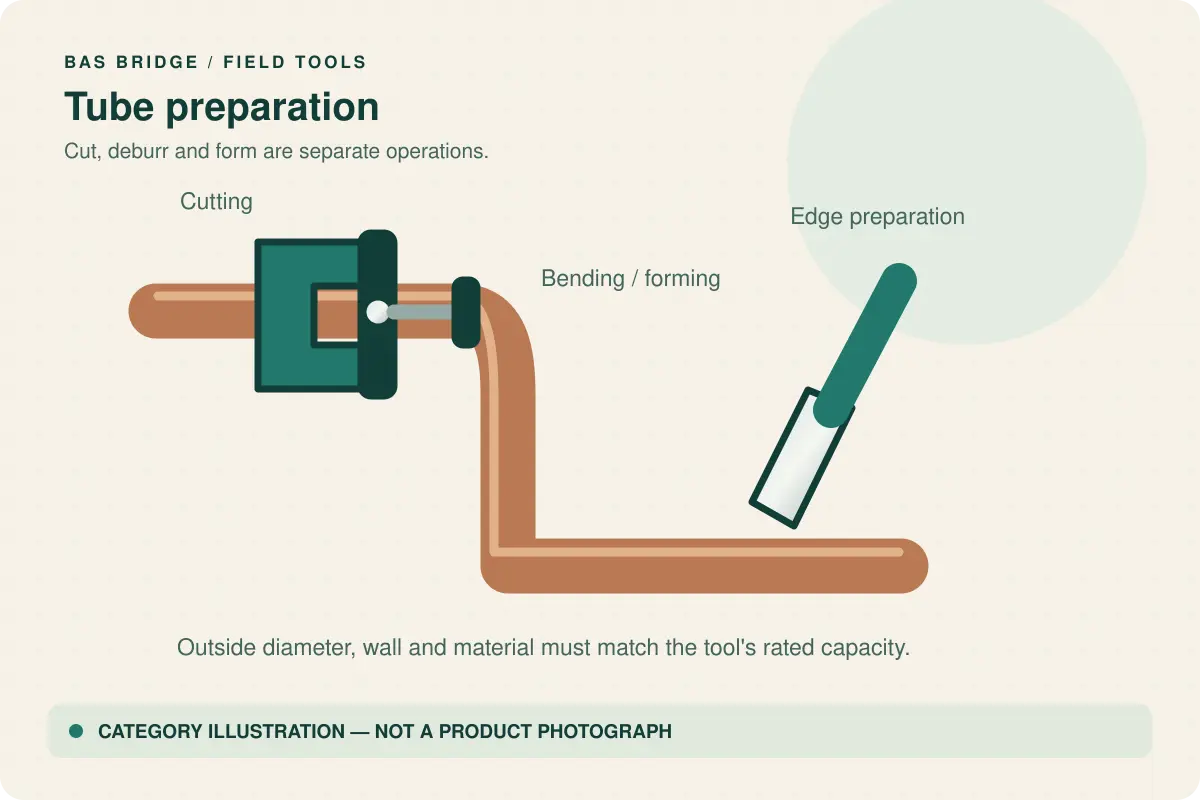
The next joining process determines the required end condition. After cutting, assess squareness, deformation, burrs, and cleanliness according to that process. The cutter performs one step; it does not certify a tube end as suitable for every fitting or service.
Control preparation debris so it does not become contamination in the equipment or line. Follow the relevant procedure for the material and application rather than borrowing a copper-flaring routine simply because both tasks involve tubing. The point of selecting a material-specific cutter is to begin with the right application, not to skip the remaining preparation checks.
Ownership costs and the final decision
Include the appropriate replacement wheel and current parts support in the cost comparison. We have not verified a current selling price, parts price, wheel replacement interval, or seller inventory. Occasional stainless work and daily stainless fabrication create different ownership cases.
Choose the 35S when stainless tubing within its documented range is a recurring requirement. For a general copper service kit, compare the appropriate copper-tubing tools rather than paying for a material-specific role that rarely occurs. Match model 35S, catalog 29963, wheel configuration, condition, and seller return support before ordering.
Reasons to consider it
- The manufacturer identifies the 35S specifically as a stainless-steel tubing cutter.
- The 1/4-to-1-3/8-inch OD capacity gives a clear sizing boundary.
- The official table specifies the E-635 standard cutting wheel.
Tradeoffs to consider
- Material and wall-thickness suitability still require the current instructions.
- The tool and feed adjustment need operating clearance around the tube.
- No independent stainless cutting, finish, or wheel-life testing was performed.
Manufacturer specification reference
RIDGID · 29963 · RIDGID 29963 35S Stainless Steel Tubing Cutter
These are manufacturer specifications, not independently measured results.
- Model / catalog number
- 35S / 29963
- Outside-diameter capacity
- 1/4 to 1-3/8 inches
- Standard wheel
- E-635
- Listed weight
- 7/8 lb
Related BAS Bridge learning
Sources & verification
Follow the current manufacturer instructions for your exact model. Specifications and source revisions can change.
- 35S Stainless Steel Tubing Cutter ↗
Official model documentation checked for the features and limits discussed in this original research review. Specifications are manufacturer claims; buying judgments are editorial analysis.
Checked Nov 2, 2026 · Source publication date: Unknown
Editorial context
Independently written BAS Bridge research review. Manufacturer features are distinguished from editorial judgments. No firsthand use or measured comparative performance is claimed. Amazon customer reviews and star ratings are not copied or synthesized into ratings.
The linked official product documentation was checked on November 2, 2026. This article combines documented features with original task-based analysis. No physical testing, service-call use, Amazon customer-review consensus or independent performance measurement is claimed.
No current price, stock level, customer star rating, or measured reliability rate is implied.
Methodology & disclosure →