Quick verdict
The 115i is a sensible addition for Testo users who need pipe temperatures viewed remotely or paired with pressure data. Buy it for that integration, while checking the exact revision, contact conditions, and accuracy required by the task.
This is a research-based review of the exact model, using the linked official documentation and original buying analysis. We have not performed hands-on or comparative testing. Amazon customer reviews and star ratings are not reproduced or represented as independent evidence.
The buying case is integration
The Testo 115i is a wireless clamp thermometer with an NTC sensor. The current US documentation for part 0560 2115 03 gives a -40°F to 302°F measurement range, ±2.3°F specified accuracy from -4°F to 185°F, 0.1°F resolution, and three AAA batteries. Match those details to the exact supplied model rather than importing a specification from an older listing or a different clamp.
The practical attraction is viewing a pipe-temperature reading without remaining beside the clamp, or including it with pressure information in the Smart App. That can simplify a distributed measurement setup. We have not timed a diagnostic visit or tested the advertised wireless behavior through walls and equipment.
Pipe contact is part of the measurement
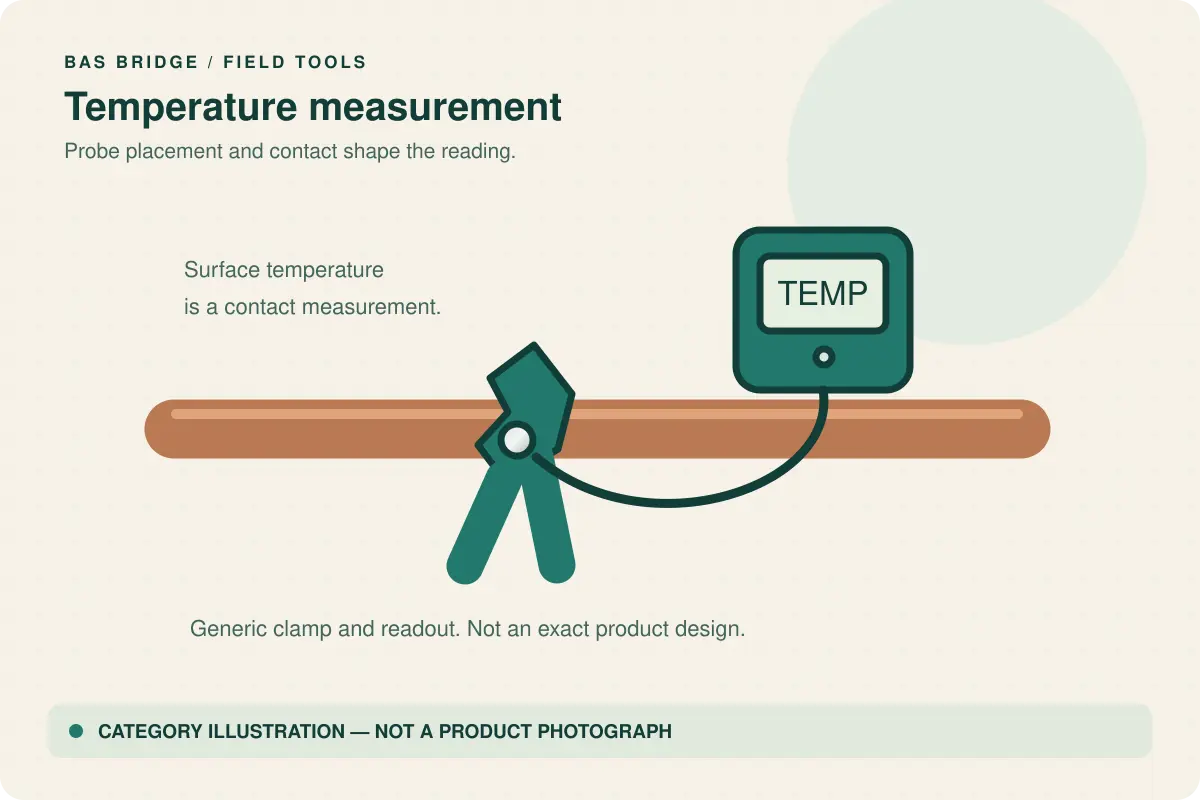
A clamp measures through its physical connection to the pipe surface. An awkward location, inconsistent contact, local heat gain, or an unrepresentative pipe section can make the number less useful for the intended diagnosis. The instrument’s specified range does not solve those application problems. Choose a location that corresponds to the physical quantity being evaluated.
For a simultaneous comparison, identify the channels clearly and allow the system and probes to behave stably. If a reading seems implausible, check the connection and location before assuming a dramatic change in equipment performance. Swapping a known suitable probe or comparing under appropriate common conditions can help separate a measurement issue from a system issue.
Superheat needs more than a temperature
When used with pressure information, a pipe-temperature probe can help calculate superheat or subcooling. The correct refrigerant data and corresponding pressure location are also essential. A wireless connection does not verify that relationship. The technician must ensure that the measured pressure and surface temperature represent the intended part of the circuit.
The clamp’s accuracy is only one contribution to the final uncertainty. Pressure uncertainty and the saturation-temperature conversion also affect the result. This is why a tenth-degree display should not be marketed as a tenth-degree system diagnosis. Consider the size of the expected difference and the consequence of an error when selecting the measurement method.
115i versus another clamp or a wired probe
The 115i is most economical when it extends equipment and reporting habits already in place. A wired Type-K arrangement may be entirely suitable when the points are close and a standalone display is preferred. The Fieldpiece JL3PC is a different sensing and platform choice; compare the physical application as well as wireless integration before choosing between them.
Confirm whether the listing contains one clamp, two clamps, or a larger kit, and inspect current support and accessory terms. This review does not claim firsthand testing of clamp strength, accuracy, response in changing conditions, or longevity. Our verdict is conditional on the documented capability matching a real need and the operator maintaining a sound pipe-temperature method.
Does 0.1°F resolution mean 0.1°F accuracy?
No. The current model’s accuracy specification is separate from its display resolution. The rest of the measurement arrangement adds its own uncertainty.
Can one 115i measure superheat alone?
No. Superheat also needs corresponding pressure and correct refrigerant data. The temperature clamp is one part of that measurement chain.
Reasons to consider it
- Wireless measurement fits an existing Testo reporting workflow
- NTC contact sensing is documented with a defined range
- Can be combined with suitable pressure data for refrigeration calculations
Tradeoffs to consider
- Contact quality and measurement location remain important
- Requires compatible viewing hardware and app
- No independent accuracy, response-time, or clamp-force tests were performed
- Assuming temperature resolution equals accuracy
- Using a surface reading as a direct refrigerant temperature under every condition
Manufacturer specification reference
Testo · 115i · Testo 115i Wireless Clamp Thermometer
These are manufacturer specifications, not independently measured results.
- Sensor
- NTC
- Temperature range
- -40°F to 302°F
- Specified accuracy
- ±2.3°F from -4°F to 185°F
- Resolution
- 0.1°F
- Power
- Three AAA batteries
Related BAS Bridge learning
Sources & verification
Follow the current manufacturer instructions for your exact model. Specifications and source revisions can change.
- Testo 115i official product information ↗
Official model documentation checked for the features and limits discussed in this original research review. Specifications are manufacturer claims; buying judgments are editorial analysis.
Checked Nov 2, 2026 · Source publication date: Unknown
Editorial context
Independently written BAS Bridge research review. Manufacturer features are distinguished from editorial judgments. No firsthand use or measured comparative performance is claimed. Amazon customer reviews and star ratings are not copied or synthesized into ratings.
The linked official product documentation was checked on November 2, 2026. This article combines documented features with original task-based analysis. No physical testing, service-call use, Amazon customer-review consensus or independent performance measurement is claimed.
No current price, stock level, customer star rating, or measured reliability rate is implied.
Methodology & disclosure →