Quick verdict
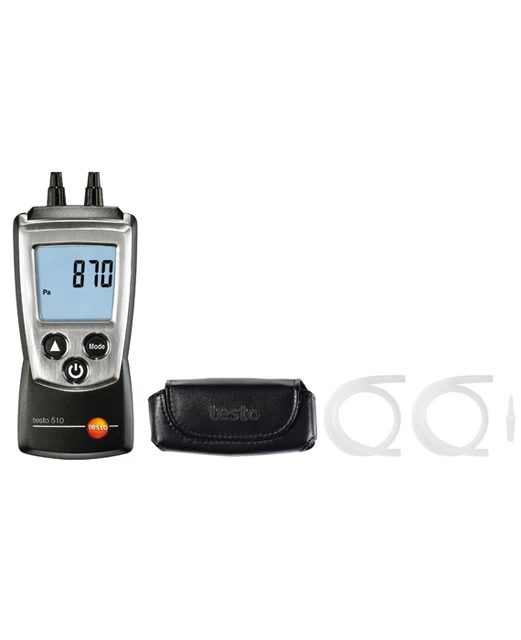
The Testo 510 set (0563 0510) is a standalone digital manometer for differential-pressure checks when you want a local display. Choose it around the pressure range, probes and recording method your work requires; the similarly named 510i is a separate phone-operated product.
Research basis
We checked Testo's product page and instruction manual on October 29, 2026. No physical unit was used or calibrated for this review. Statements about suitability are editorial interpretation of the documents; there are no measured battery-life, drop-resistance or side-by-side accuracy results here.
Testo 510 accuracy and specification differences
The official product page identifies the standalone set. The instruction manual supplies the resolution and the conditions attached to accuracy below.
| Item | Documented specification |
|---|---|
| Exact set | 510; order number 0563 0510 |
| Differential range | 0 to 100 hPa |
| Manual resolution | 0.01 hPa; 0.01 inH₂O |
| Low-range accuracy | ±0.03 hPa at 0–0.30 hPa, ±1 digit; nominal 22 °C |
| Protection | IP40 |
| Power | Two AAA batteries |
The US page displays 0.00 inH₂O resolution and rounds away the fixed term in one imperial accuracy expression. The manual instead gives 0.01 inH₂O resolution and a 0.04 inH₂O fixed term in its upper-range formula. We use the manual values and do not interpret those rounded web fields as zero error.
That is a buying issue because small pressure differences can make display digits appear more decisive than they are. When an acceptance limit is close to a reading, use the full specification and the correct document revision. Resolution and measurement uncertainty answer different questions.
Make the pressure question precise
Before selecting an instrument, describe the comparison you need. Filter pressure drop, a duct reference and a component differential are different observations. Each needs the right pressure locations and a record of how the system was operating. A compact meter cannot select those locations for you.
For example, two filter readings taken at different fan conditions may not be comparable evidence of loading. Keep the operating condition and measurement arrangement consistent before attributing a change to the filter. Use the installed equipment and filter documentation for applicable limits; this review supplies no universal replacement threshold.
A useful job note includes units, both pressure connections, fan state and any important damper or access-panel condition. If another technician cannot reproduce the arrangement, the number has less value for a future comparison. Plan that record before deciding whether app-based reporting is essential.
Zeroing and mounting are connected
The Testo manual says to zero before each measurement and to avoid changing the meter's position afterward. Its explanation is position-related error and zero-point drift. Treat the magnetic backing as a way to establish a stable position, then follow the documented setup sequence.
For buying purposes, consider where the tool will sit on your normal equipment. Check display access and whether both hoses can reach without awkward strain. A meter that fits in a pocket may still require additional tubing or probes to make a useful measurement at the intended locations.
If a reading changes unexpectedly, inspect the arrangement before blaming a component. Tubing, connections, port placement and operating changes are all candidates for a controlled check. A repeatable process helps distinguish a real system change from a measurement change.
Optional Pitot use adds another job
Testo documents velocity measurement with an optional Pitot tube. The manual also requires the correct density unit and value for that mode. The meter alone therefore does not constitute a complete airflow-measurement kit.
Decide whether your actual work calls for that method. Access, the measurement location and an appropriate sampling plan affect whether a result represents the airflow of interest. A single convenient point should not automatically become a whole-duct volume-flow claim.
If routine work mostly involves differential pressure, do not give optional velocity capability the same weight as a function you will use every day. If airflow surveys are central, compare the complete method and accessories with a vane instrument, thermal probe or suitable hood before selecting a kit.
Standalone display or an app-based manometer?
A local display reduces dependence on phone charge, permissions and wireless setup. The tradeoff is the process for recording readings and attaching them to the job. Some technicians prefer a short written measurement sheet; others need a connected report workflow. Neither preference establishes instrument accuracy.
The relevant comparison is whether the complete workflow preserves enough context. A beautifully formatted report with unclear pressure locations is weak evidence. A clear manual record may be useful if it identifies the arrangement and operating state. Select the reporting method around the people who must use the result.
Ownership and buying checklist
- Confirm the 510 set number and the hoses, pouch and supplied documentation in the offer.
- Price suitable static-pressure probes or a Pitot tube separately when required.
- Check tubing condition, replacement availability and a practical storage arrangement.
- Ask about calibration or service support if your work requires documented instrument checks.
Current prices and service costs have not been verified. IP40 is a documented enclosure classification, not evidence of waterproof field performance. Consider how you will protect the tool and its pressure connections during transport and use.
The 510 makes sense when compact standalone pressure measurement solves a regular need. Spend the rest of the decision on the probes, range and recording method. Those details determine whether the purchase becomes a useful measurement kit rather than simply another number on a display.
Manufacturer specification reference
Testo · 510 / 0563 0510 · 510 Differential Pressure Manometer Set
These are manufacturer specifications, not independently measured results.
- Exact set
- 510; order number 0563 0510
- Differential range
- 0 to 100 hPa
- Manual resolution
- 0.01 hPa; 0.01 inH₂O
- Low-range accuracy
- ±0.03 hPa at 0–0.30 hPa, ±1 digit; nominal 22 °C
- Protection
- IP40
- Power
- Two AAA batteries
Related BAS Bridge learning
Sources & verification
Follow the current manufacturer instructions for your exact model. Specifications and source revisions can change.
- Testo 510 US product page ↗
Set identity, local display, magnetic mounting, accessories and metric differential-pressure range. The US page rounds some imperial specification values; the article identifies that limitation.
Checked Oct 29, 2026 · Source publication date: Unknown - Testo 510 instruction manual ↗
English specifications, nominal-temperature and digit conditions, resolution, zeroing without changing position, optional Pitot configuration and maintenance.
Checked Oct 29, 2026 · Source publication date: Unknown - Testo 510 / 0563 0510 official product image ↗
Exact-model image linked from the manufacturer product page and visually checked for product identification. The image is not evidence of BAS Bridge ownership or testing.
Checked Oct 29, 2026 · Source publication date: Unknown
Editorial context
BAS Bridge editorial prepared this documentation-based research overview and buying analysis. No firsthand experience, physical measurement or independent performance test is claimed.
Manufacturer documentation checked on October 29, 2026. Buying recommendations are original editorial interpretation of that documentation, with no physical product testing.
No current price, stock level, customer star rating, or measured reliability rate is implied.
Methodology & disclosure →