Quick verdict
The Klein ET05 suits local air and contact temperature checks when a pocket probe and its own display are enough. Confirm the supplied unit’s accuracy before close-tolerance work: Klein’s product page and linked instructions give different figures. Choose a different arrangement when simultaneous readings, pipe-clamp contact, or humidity measurement is required.
This is a research-based review. We have not compared an ET05 with a reference thermometer or evaluated response time, sunlight readability, or durability.
Pros supported by the design
- Integrated display with Fahrenheit and Celsius selection.
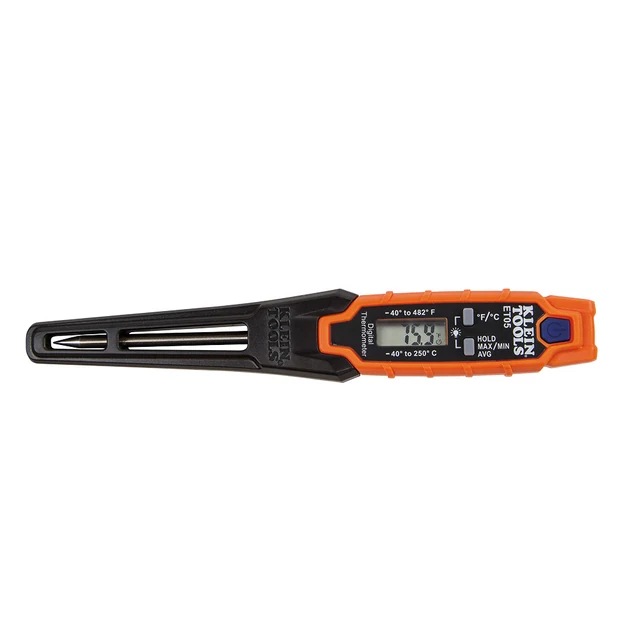
- A protective sheath, pocket clip, and compact probe format.
- Hold and summary functions for local readings.
Limitations to consider
- One probe does not provide simultaneous supply and return readings.
- Published accuracy documents disagree.
- It does not measure humidity or provide a pipe-clamp attachment.
What the ET05 is designed to measure
Klein describes the ET05 as an ambient and direct-contact thermometer. The product page lists a -40 to 482°F range, a three-inch stainless-steel probe, a backlight, Max/Min/Hold/Average functions, and two LR44 batteries. The sheath can also serve as a handle. These features describe the tool’s intended capabilities; they are not results of testing by this site. Klein ET05 product page.
The instruction sheet specifies 0.1-degree display resolution. That is the smallest displayed increment, not a promise of one-tenth-degree accuracy. A useful purchase decision starts with the tolerance the job requires rather than the number of digits on the screen.
Klein ET05 accuracy: why the official figures differ
The product page states room-temperature accuracy of ±2.7°F (±1.5°C). The currently linked instructions, based on revision 05/25 A, instead list ±1.8°F (±1°C) for the -3 to 302°F band, with wider limits in other bands. Both are official Klein sources accessed for this review. Product specifications, linked instructions.
We cannot establish from those documents whether the difference reflects a revision, a documentation error, or another distinction. Until the specification for the supplied unit is confirmed, we would plan conservatively around the wider room-temperature figure. A purchase that depends on the tighter tolerance deserves confirmation from Klein before ordering.
For perspective, a displayed 70.0°F reading with a ±2.7°F instrument allowance spans 67.3 to 72.7°F before measurement-placement effects are considered. That calculation illustrates the specification; it is not an observed ET05 error. Small displayed changes can therefore deserve less confidence than their neat decimal presentation suggests.
Can the ET05 check supply and return air temperatures?
The ET05 is easiest to justify for a local reading that can be taken and viewed in the same place. Before choosing it, picture where the probe must sit and where your hand and eyes will be. A compact all-in-one design is less convenient if the measurement point is hidden or cannot be reached while you read the display.
Sequential supply and return readings may be enough for a broad comparison, but they represent two moments. If operating conditions change between them, the difference can include that change. A pair of suitable probes is worth considering when comparing two locations at the same time is central to your work.
The tool also deserves realistic scope. Air temperature alone is not humidity, and a single reading does not establish airflow. Avoid spending for a wireless kit if you need only a local temperature; equally, avoid treating a pocket thermometer as a substitute for all the measurements a diagnostic decision requires.
Its physical probe format is another selection point. For repeated pipe-temperature measurements, compare it with a purpose-designed contact or clamp arrangement. The fact that two tools both display temperature does not establish equivalent contact, access, or convenience.
Operating limits that affect the purchase
The measurement range and allowable body temperature are different. The linked instructions limit the plastic body and sheath to 160°F, with only brief higher-temperature exposure permitted for the stainless probe. They also warn that the thermometer is not insulated and call for shutting off power where energized conductive parts may be present. Klein ET05 instructions.
That makes the advertised upper measuring range a poor reason to buy it for an entire instrument exposed to high heat. Choose around the actual arrangement, including what surrounds the display and handle.
The two LR44 cells are small enough to be easy to overlook when restocking a service bag. Check their local replacement cost and availability alongside the thermometer’s purchase price. We have not verified replacement prices, so no annual running-cost estimate is claimed here.
Alternatives and recommendation
An infrared thermometer is a different tool. The Klein IR1 review explains the surface-temperature approach and why aiming at a grille does not provide the same measurement as placing a suitable probe in air. Pick the method that answers your question before comparing brand names.
A remote display or wireless probe system deserves consideration if you frequently need to leave the sensing element in one location and read elsewhere. Those features can solve an access problem, but they introduce a larger purchasing decision. For occasional local measurements, a simple display can remain a sensible preference.
Consider the ET05 if you want a pocket-sized standalone thermometer and its confirmed accuracy meets your application. Resolve the documentation difference if a close tolerance matters. Choose another arrangement when simultaneous readings, pipe-clamp contact, humidity, or remote monitoring are regular requirements. Our recommendation rests on those task limits, not a claim that this unit has been field tested by us.
Manufacturer specification reference
Klein Tools · ET05 · ET05 Digital Pocket Thermometer
These are manufacturer specifications, not independently measured results.
- Measurement range
- -40 to 482°F (-40 to 250°C)
- Probe
- 3-inch stainless steel
- Power
- Two LR44 cells
- Product-page accuracy
- Room temperature ±2.7°F (±1.5°C)
- Accuracy source conflict
- Linked 05/25 A instructions instead state ±1.8°F (±1°C), -3 to 302°F; exact supplied-unit specification unresolved
- Body/sheath limit
- 160°F per linked instructions; probe only for brief higher-temperature exposure
Related BAS Bridge learning
Sources & verification
Follow the current manufacturer instructions for your exact model. Specifications and source revisions can change.
- Klein ET05 specifications ↗
Official documentation consulted for the documented capabilities and limitations. The article distinguishes source specifications from editorial interpretation.
Checked Oct 29, 2026 · Source publication date: Unknown - Klein ET05 instructions, based on revision 05/25 A ↗
Official documentation consulted for the documented capabilities and limitations. The article distinguishes source specifications from editorial interpretation.
Checked Oct 29, 2026 · Source publication date: Unknown - Klein Tools ET05 official product image ↗
Exact-model image linked from the manufacturer product page and visually checked for product identification. The image is not evidence of BAS Bridge ownership or testing.
Checked Oct 29, 2026 · Source publication date: Unknown
Editorial context
Published by BAS Bridge from linked manufacturer documentation and original buying analysis. The review does not claim firsthand experience or independent performance measurements.
Manufacturer product information and operator documentation were checked on October 29, 2026. Practical buying conclusions are editorial analysis; no physical testing or service-call experience is claimed.
No current price, stock level, customer star rating, or measured reliability rate is implied.
Methodology & disclosure →