Quick verdict
The 310 II is a useful shortlist option for qualified technicians whose heating work fits its documented sensors, ranges, and reporting workflow. Include calibration, condensate care, and downtime in the purchase rather than judging it by the analyzer price alone.
This is a research-based review of the exact model, using the linked official documentation and original buying analysis. We have not performed hands-on or comparative testing. Amazon customer reviews and star ratings are not reproduced or represented as independent evidence.
The sensor configuration is a buying decision
The Testo 310 II documentation identifies direct O₂, CO, temperature, draft, and pressure measurements, with calculated combustion outputs. Its listed O₂ range is 0–21 vol.%, while CO is listed from 0–4,000 ppm without H₂ compensation. That qualification matters when deciding whether the instrument matches the intended fuels, equipment, and measurement requirements.
This is a documentary review, not a reference-gas evaluation. BAS Bridge has not tested the analyzer’s accuracy, cross-sensitivity, response after heavy exposure, or performance against another combustion instrument. A broad feature list should not be turned into a claim that one sensor configuration is appropriate for every heating and industrial application.
A report needs a defined test
The 310 II can support a useful combustion record, but a report becomes meaningful through its context. Identify the appliance, fuel, firing condition, sampling point, and the required comparison criteria. A set of readings taken at partial load may answer a different question from a specified high-fire commissioning test.
Separate direct measurements from calculated values. The efficiency display is not a complete test of appliance safety or building conditions. Selected fuel data, input measurements, and the calculation basis affect derived figures. The technician still needs the appliance’s instructions and the other observations required to assess combustion, venting, and operation.
Condensate and filters belong in the workflow
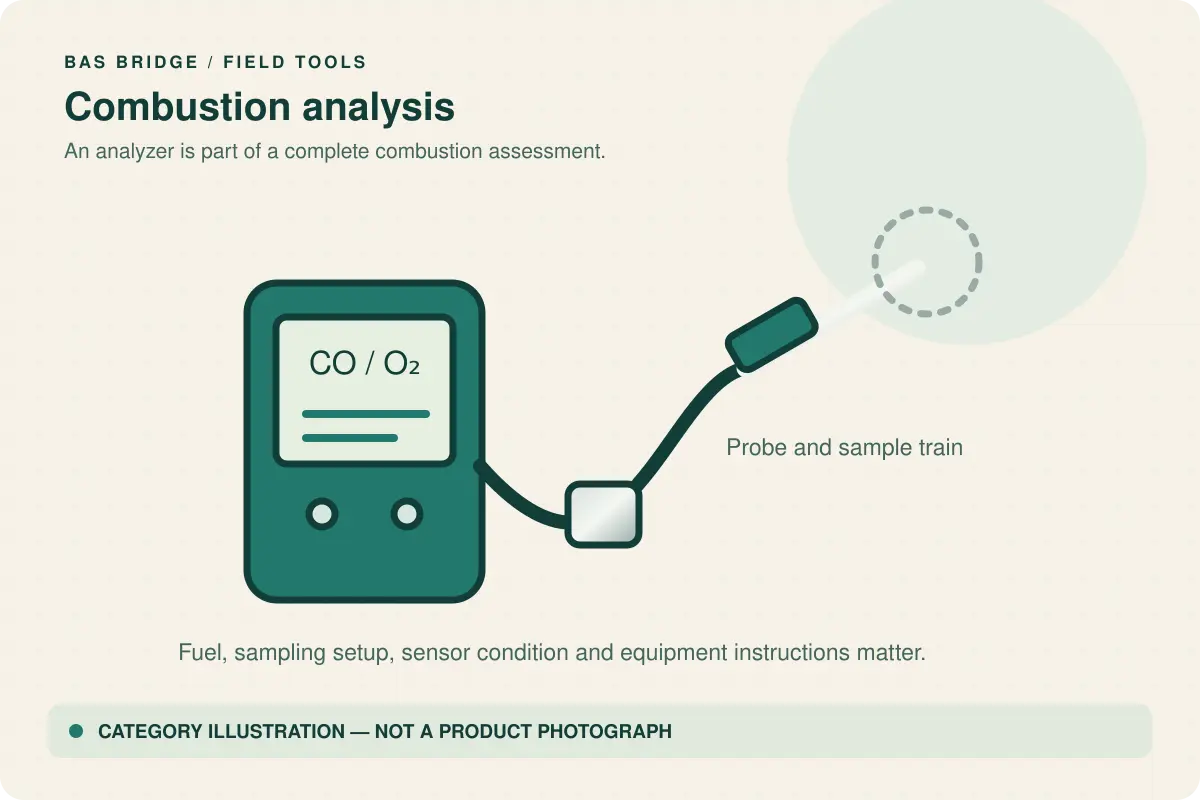
Testo documents a condensate trap that can be emptied and a replaceable particle filter. These are practical ownership features, but they also identify work the operator must perform. The sample path needs to remain suitable for measurement; allowing water or contamination to compromise it can weaken the result even when the screen continues to display numbers.
Follow the current manual for fresh-air zeroing, sampling, purging, cleaning, and storage. A startup countdown is not proof that the surrounding air was appropriate for zeroing. Maintenance and verification need to fit the actual service conditions, particularly if the instrument is repeatedly exposed to demanding or dirty combustion equipment.
Include calibration and the correct package
Before purchasing, identify the calibration route, required documentation, service interval, expected downtime, and any backup arrangement. A lower initial price can be less attractive if the service process does not fit the working schedule. Consumables and eventual sensor-related service belong in the real ownership comparison.
Also distinguish the analyzer configuration from a package that includes a printer; similar names can hide different contents. Compare the 310 II with the Fieldpiece CAT45 on sensor suitability, sample care, reporting, service support, and total cost. Choose the 310 II when those documented capabilities fit the work. It does not replace a dedicated personal CO safety device or qualified interpretation of appliance-specific requirements.
Does the 310 II have H₂-compensated CO measurement?
The official specification consulted describes the CO measurement as without H₂ compensation. Verify that this sensor configuration is suitable for the intended application.
Does the efficiency number prove the appliance is safe?
No. It is a calculated combustion output. Safety and proper operation require the full appliance-specific assessment and appropriate ambient CO awareness and protection.
Reasons to consider it
- Combines gas, temperature, draft, and pressure observations
- Serviceable condensate trap and filter are documented
- Smart App supports reports; printer configurations are identified separately
Tradeoffs to consider
- Sensor suitability and ranges need to match the job
- Calibration and maintenance are continuing obligations
- No independent reference-gas, cross-sensitivity, or comparative tests were performed
- Using a combustion analyzer as a personal CO alarm
- Assuming a non-H₂-compensated CO measurement suits every application
Manufacturer specification reference
Testo · 310 II · Testo 310 II Combustion Analyzer
These are manufacturer specifications, not independently measured results.
- Direct measurements
- O₂, CO, temperatures, draft and pressure
- CO range
- 0–4,000 ppm, without H₂ compensation
- O₂ range
- 0–21 vol.%
- Condensate
- Serviceable condensate trap and particle filter
- Documentation
- Testo Smart App; printer version separate
Related BAS Bridge learning
Sources & verification
Follow the current manufacturer instructions for your exact model. Specifications and source revisions can change.
- Testo 310 II official product information ↗
Official model documentation checked for the features and limits discussed in this original research review. Specifications are manufacturer claims; buying judgments are editorial analysis.
Checked Nov 2, 2026 · Source publication date: Unknown
Editorial context
Independently written BAS Bridge research review. Manufacturer features are distinguished from editorial judgments. No firsthand use or measured comparative performance is claimed. Amazon customer reviews and star ratings are not copied or synthesized into ratings.
The linked official product documentation was checked on November 2, 2026. This article combines documented features with original task-based analysis. No physical testing, service-call use, Amazon customer-review consensus or independent performance measurement is claimed.
No current price, stock level, customer star rating, or measured reliability rate is implied.
Methodology & disclosure →