Quick verdict
The 316-3 is worth considering for a simple heated-diode search workflow where replacement sensors and exact refrigerant suitability can be confirmed. Check regional support and seller stock carefully rather than assuming an older familiar model is equally supported everywhere.
This is a research-based review of the exact model, using the linked official documentation and original buying analysis. We have not performed hands-on or comparative testing. Amazon customer reviews and star ratings are not reproduced or represented as independent evidence.
An exact-model check matters here
The US manufacturer page still documents the Testo 316-3, while product availability and support can differ by region. This review uses the US 0563 3163 identity and does not claim current Amazon stock. The official page lists a heated-diode sensor, 4 g/year or 0.15 oz/year sensitivity, high/low selection, automatic zeroing, two D batteries, and a replaceable sensor head.
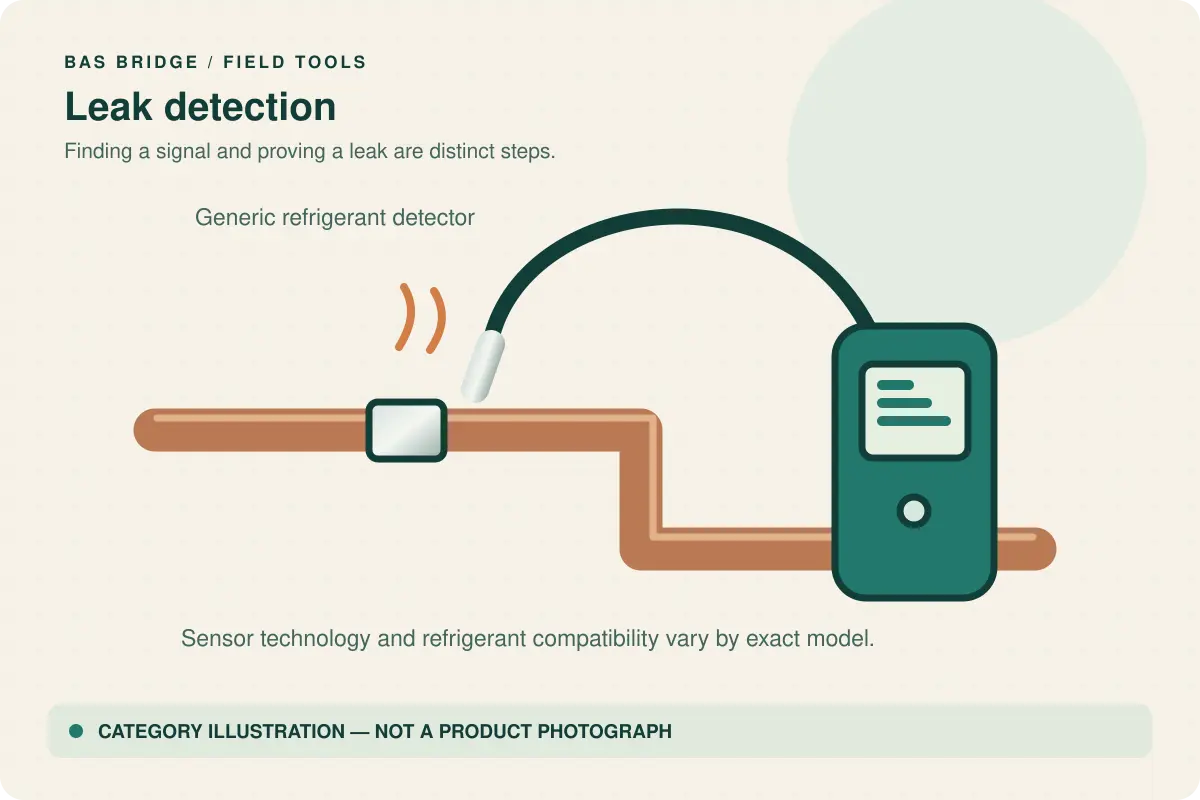
That is a recognizable simple-tool proposition: a detector that supplies local audible and visual feedback without requiring a phone interface. It may suit someone who wants straightforward controls, but the purchase should include a check for genuine replacement sensors, filters, support, and current refrigerant documentation.
Treat the sensor as a working consumable
The manufacturer lists an approximate 80–100-hour sensor life. That is not a promise of equal performance until a fixed hour counter expires, nor proof that every sensor will last a particular number of calendar years in service. Exposure, storage, and care matter. The relevant ownership plan includes a functional check and a route to replacement parts.
A detector can appear healthy in the bag and still fail to provide a useful response at the job. Battery condition and sensing condition are separate questions. When comparing it with the DR58 or an infrared detector, include the maintenance model and the availability of the correct replacement parts rather than comparing only the initial price.
Automatic zeroing needs an understood search method
Automatic adjustment around background refrigerant can be helpful, but it changes how the instrument responds to the conditions around the tip. The operator needs to understand the current manual’s search procedure rather than sweep quickly and interpret the absence of an alarm as proof that no leak exists.
Air movement and general contamination can also make localization difficult. The useful evidence is a repeatable response associated with a specific area under a sensible method. After a repair, the required confirmation is a separate task; finding refrigerant before repair and proving the repaired arrangement meets the relevant test criteria are different things.
Where it fits in the shortlist
The 316-3 is easier to recommend when its simple controls match the user’s preference and its support position is clear. Its documented refrigerant capability must be checked for the actual job and unit. An A2L statement should not be generalized into detection of every flammable gas or suitability for every refrigerant category.
We have not challenged this model with calibrated reference leaks, compared response speed, or tested contamination recovery. The verdict is based on the official documentation and the practical importance of a maintainable detector. Compare the complete current cost with a DR58 or DR82, and choose on supported capability, care, and the kind of search you actually perform.
Does an alarm tell me the leak rate?
An alarm is search evidence. Do not present it as an independent calibrated measurement of leak rate or as the required post-repair verification.
Is battery replacement the only maintenance cost?
No. The official page identifies a replaceable sensing head and an approximate sensor life. Verify sensor and filter availability as part of the purchase.
Reasons to consider it
- Simple high/low sensitivity and automatic-zero controls
- User-replaceable sensor is documented
- Audible and LED indications offer basic search feedback
Tradeoffs to consider
- Official typical sensor life is only one part of ownership planning
- Regional availability and support require checking
- No independent leak challenge or false-response testing was performed
- Quantifying a leak rate from an alarm response
- Assuming a detector remains sensitive because it powers on
Manufacturer specification reference
Testo · 316-3 · Testo 316-3 Heated-Diode Refrigerant Leak Detector
These are manufacturer specifications, not independently measured results.
- Sensor
- Heated diode
- Stated sensitivity
- 4 g/year / 0.15 oz/year
- Typical sensor life
- 80–100 hours
- Power
- Two D batteries
- Controls
- High/low sensitivity and automatic zeroing
Related BAS Bridge learning
Sources & verification
Follow the current manufacturer instructions for your exact model. Specifications and source revisions can change.
- Testo 316-3 official product information ↗
Official model documentation checked for the features and limits discussed in this original research review. Specifications are manufacturer claims; buying judgments are editorial analysis.
Checked Nov 2, 2026 · Source publication date: Unknown - Testo 316-3 official product information ↗
Official model documentation checked for the features and limits discussed in this original research review. Specifications are manufacturer claims; buying judgments are editorial analysis.
Checked Nov 2, 2026 · Source publication date: Unknown
Editorial context
Independently written BAS Bridge research review. Manufacturer features are distinguished from editorial judgments. No firsthand use or measured comparative performance is claimed. Amazon customer reviews and star ratings are not copied or synthesized into ratings.
The linked official product documentation was checked on November 2, 2026. This article combines documented features with original task-based analysis. No physical testing, service-call use, Amazon customer-review consensus or independent performance measurement is claimed.
No current price, stock level, customer star rating, or measured reliability rate is implied.
Methodology & disclosure →